The Legend
In 1882, the ancestors of today's owner, Anton Schüle, came into possession of the land and grounds of the estate. Farmhouses had already stood in the area around the present buildings long before that. The Martinsteinhiesli itself was built in 1620, according to the cornerstone above the cellar door. Remains of old walls were also found near what is now known as the Martinstein (Martin's Stone). This is the legend behind it:
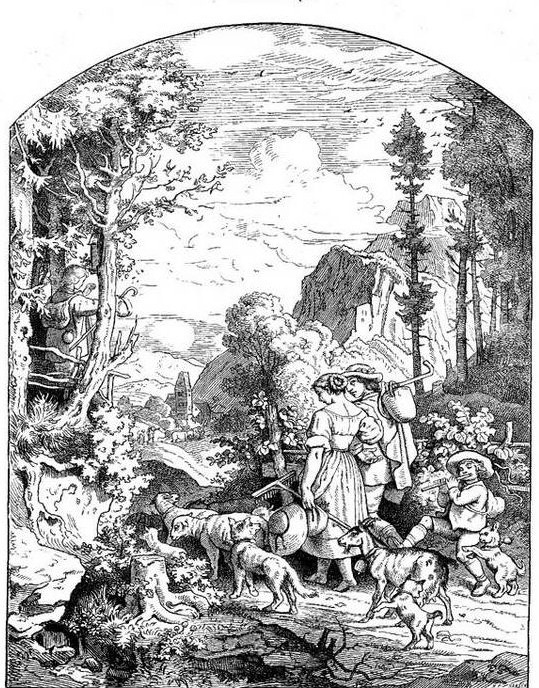
Der Martinstein
High above the valley of the Reichenbach, at a place called the Hohgrund (the "high ground"), there once lived a family of farmers, strong and known far and wide. The best plowman among them was Martin Späth, and every evening he said his night prayer at a mighty stone that stood not far from the farm.
The stone has been called the Martinstein (Martin's stone) ever since. And to this day, so the old telling goes, you can see pressed deep into it the mark of his knee, the tip of his stick and his rosary — for he prayed there every day, until at last he was carried to his rest.
Often in the evening he heard a bell ringing up from the valley, though no church stood there yet. It was a bell from heaven. Then he would lay down his work and hurry to the stone, to give praise and thanks in that holy place. Mostly he heard it at dusk; but on Saturdays the heavenly bell rang in the holy day as early as midday, and on that day he left off work sooner than on the others.
Only once did he fail to go. It was harvest time, and he wanted first to bring the last wagonload of sheaves under the roof, so when the bell rang he did not go up to the stone. That day the bell no longer sounded for him, and his grief was more than words can tell. Eight days it lasted. Then he heard it again, as clear and beautiful as before, and from then on he never once missed the walk — however much people scolded him and mocked him for it.
When they told him it was all an empty delusion, he cried out: "As surely as this sickle can stand still in the sky, so surely do I hear the bell ring!" And he threw it up — and before the eyes of them all it stayed there, standing in the sky like the moon.
As a reward for his faithful prayer, it was revealed to him at the stone that piety would never die out on his farm.
But the stone is not the only thing that remembers him; there is also the church in the cemetery at Gengenbach. When Martin felt his end drawing near, he gathered his household around him and told them what was to be done. The finest cow of the farm, he said, would bear two black calves, each of them a wild bull. When they were grown, they were to be yoked — animals that had never borne a yoke — to draw him to his grave.
The family were to step aside and let the animals run where they would. Where they first rested, a Bildstock (a wayside shrine) was to be raised. Where they stopped a second time, a chapel was to be built in the forest. And where they stopped a third time, there he was to be buried, and over his grave a church was to stand in Saint Martin's honor. As he spoke, his eyes shone, and every word rang as though it were the voice of God himself.
It happened just as he had said. The Bildstock, the chapel and the church all stand where the animals stopped. But at the third place the people did not want to build, and they began to raise the church nearer the town instead. The next morning the timber lay back at the old place. And after a scoffer died, no one ever carried it away again. The church stands there to this day, ringed by many, many graves — God rest them all.